What will make me happy?
First of all-- I had to put this in here-- one thing in the recent past has made me very, very happy. My class has, at last, finished 'The Woman Warrior', and while there is still a final paper to be written, I nonetheless greatly enjoyed the feeling of slamming that [expletive deleted] book shut.
Now on to the real post.
At 4:30 on April 27th, a bit more than a week from now, I will be sitting in an auditorium, preparing for my first band performance of 2007. Normally this would be a happy-- maybe a bit stressful-- occasion, but fun. Nothing to worry too much about-- after all, if you know the music, what could go wrong? Sadly, if you are first chair and have a solo, the answer is 'everything.'
Don't get me wrong-- I absolutely love band, love playing French Horn, and was thrilled to find that my favorite song of the concert (Into the Raging River by Steven Reineke) contained two solos for me to play. But as the performance approaches, I am getting more than a bit nervous. While I can play the music, and normally don't get nervous attacks at concerts, solo is obviously very different. Playing forte while everyone else is playing piano (or not playing at all) is fine. But doing so in front of a large crowd of people-- some of whom are judges-- is not.
I am not a stranger to panic attacks--I've had them during auditions, before performances, when a Certain Someone is in the vicinity-- and they are not pleasant. All I can say is that sweaty hands and a high heart rate are not going to help my musicality.
But now to cut off the rant of stress and panic. I am doing my best to view these solos as an opportunity. I have a chance to perform and show my love of music to people outside of my school, a chance for me, and me alone, to convey that love of music to everyone listening. If I focus on that, instead of imagining bloodthirsty judges with pencils poised to record every mistake (too late!), I know that I'll be able to overcome the panic and play for the reason I am in band: because I love music. And music makes me very, very happy. And by thinking of that, by getting lost in the music instead of the stage-lights, I can play well. Which will also make me very happy.
Marching Band

Showing posts with label Woman Warrior. Show all posts
Showing posts with label Woman Warrior. Show all posts
Tuesday, April 17, 2007


Thursday, March 29, 2007
Assigned Post: The Chinese Cultural Revolution
In 'The Woman Warrior,' Maxine's extended family back in China suffers greatly from the Chinese Cultural Revolution, or 'Chinese Civil War.' Mrs. Watson has asked that we research the Revolution and post our findings.
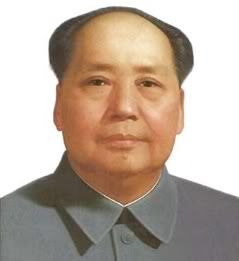 The Cultural Revolution was started in October of 1966 by China's Chairman Mao (pictured to the left). Mao wanted to completely remodel, or 'purify,' China, and he wanted complete and organized control. In the ten years of the Cultural Revolution, he got that.
In order to get support for the Revolution, Mao set up the Red Guards, an organization of student supporters. The Red Guard quickly became wildly popular-- in part because Mao, who was greatly admired by most of the people of China, praised it so much-- and almost every young student dreamed of joining it one day.
The Red Guard was one of the main forces of the Revolution, and helped greatly in achieving the Revolution's goal: to destroy the 'four olds.' The four olds were old ideas, habits, customs, and culture. By getting rid of the four olds, they were also getting rid of an old way of thinking-- the Revolution was as much a revolution of the minds of the people as of a country.
But the destruction of the four olds-- and everything to do with them-- was very violent. Anyone suspected of being traitorous of Chairman Mao could be killed. Innocent people were forced out of their homes, fired from their jobs, forced to work without pay 'for the good of the country,' murdered, tortured, publicly beaten, and so on. Public humiliation was another popular process of punishment Some victims were made to kneel without moving for hours on broken glass while their houses were torn apart in a vicious search for any kind of incriminating evidence. Some families that needed to 'rethink' their loyalties were relocated to farms out in the country, where they had to perform back-breaking labor for the nation.
Another goal of the Revolution was complete equality. Mao's government blamed the upper class of doctors, lawyers, teachers, and especially landlords, for the suffering of the poor. So anyone who was in any of those professions, and their relatives-- no matter how distant-- were suddenly criminals. The Red Guard locked up, tortured, and killed China's upper class-- something that was, essentially, the nation's suicide. They were murdering the brightest and most important minds in their country... all in the name of equality.
So despite its initial wild popularity, members of the Red Guard began questioning the ethics of the Revolution. The movement lost momentum, and popularity faded. The official date of the Revolution's end is 1977, one year after Mao's death.
I got most of my information from a book I read several years ago called 'Red Scarf Girl,' which is the true story of a young girl in China during the Revolution. The rest of my information comes from http://acc6.its.brooklyn.cuny.edu/~phalsall/texts/chinhist.html . The picture is from photobucket.com
The Cultural Revolution was started in October of 1966 by China's Chairman Mao (pictured to the left). Mao wanted to completely remodel, or 'purify,' China, and he wanted complete and organized control. In the ten years of the Cultural Revolution, he got that.In order to get support for the Revolution, Mao set up the Red Guards, an organization of student supporters. The Red Guard quickly became wildly popular-- in part because Mao, who was greatly admired by most of the people of China, praised it so much-- and almost every young student dreamed of joining it one day.
The Red Guard was one of the main forces of the Revolution, and helped greatly in achieving the Revolution's goal: to destroy the 'four olds.' The four olds were old ideas, habits, customs, and culture. By getting rid of the four olds, they were also getting rid of an old way of thinking-- the Revolution was as much a revolution of the minds of the people as of a country.
But the destruction of the four olds-- and everything to do with them-- was very violent. Anyone suspected of being traitorous of Chairman Mao could be killed. Innocent people were forced out of their homes, fired from their jobs, forced to work without pay 'for the good of the country,' murdered, tortured, publicly beaten, and so on. Public humiliation was another popular process of punishment Some victims were made to kneel without moving for hours on broken glass while their houses were torn apart in a vicious search for any kind of incriminating evidence. Some families that needed to 'rethink' their loyalties were relocated to farms out in the country, where they had to perform back-breaking labor for the nation.
Another goal of the Revolution was complete equality. Mao's government blamed the upper class of doctors, lawyers, teachers, and especially landlords, for the suffering of the poor. So anyone who was in any of those professions, and their relatives-- no matter how distant-- were suddenly criminals. The Red Guard locked up, tortured, and killed China's upper class-- something that was, essentially, the nation's suicide. They were murdering the brightest and most important minds in their country... all in the name of equality.
So despite its initial wild popularity, members of the Red Guard began questioning the ethics of the Revolution. The movement lost momentum, and popularity faded. The official date of the Revolution's end is 1977, one year after Mao's death.
I got most of my information from a book I read several years ago called 'Red Scarf Girl,' which is the true story of a young girl in China during the Revolution. The rest of my information comes from http://acc6.its.brooklyn.cuny.edu/~phalsall/texts/chinhist.html . The picture is from photobucket.com
Wednesday, March 28, 2007
Assigned Post: Ghost Stories
In English, we are currently reading The Woman Warrior by Maxing Hong Kingston. In the chapter that we just read, Maxine's mother tells many ghost stories to Maxine and her siblings. In class, we told our own ghost stories, and Mrs. Watson asked us to post them on our blogs.
Many years ago, my high school was a boarding school, and students lived there for the entire school year. Castle Hall, a building now used for art, was the location of the girls' dormitories. The following story is one that people in my school love to tell-- among our other school ghost stories-- and takes place in Castle Hall during the old boarding school days.
Late one night, during the last few months of school, a girl woke her room-mates in a panic, telling them that the school was on fire. The girls looked up at the long, thin windows at the top of the wall that separated them from the hallway-- and sure enough, they could see flickering firelight through the glass panes. But before they could do anything, they also heard chanting-- chanting in Hawaiian.
"It's the Night Marchers," one dark-haired girl said in a hushed voice.
[To anyone who does not know what the Night Marchers are, please read this short Wikipedia article: http://en.wikipedia.org/wiki/Night_marchers ]
"What are you talking about?!" snapped the first girl. "Don't be so superstitious! It's a fire, and we need to warn people!" With that, she ran to the door and seized the handle. As soon as she touched the knob, she screamed and jerked her hand away-- it was horribly burnt.
Almost instantly, the chanting stopped, and the firelight disappeared. Soon after, the girls could hear people running to their room to see what had happened. Teachers took girl with the burnt hand was taken to the hospital, leaving the others to whisper about what had happened.
The dark-haired girl told the others about the chanting and the light of the torches, and how she suspected it was the Night Marchers.
"But why would the Night Marchers be up here on the second floor of Castle Hall?" asked another girl skeptically.
"Well, there used to be a hill here, right? But they bulldozed it to make the building. When the Ancient Hawaiians were here, the ground was probably around the same level as this floor is. So they're still marching where the ground was then, when they were alive."
A few of the girls remained disbelieving, but most of those who had seen their friend's burnt hand were not so quick to deny that maybe the legend was true, and that their school-- like so many stories told-- was haunted.
There are many tales of ghosts in our school, but I chose this one because I spent a year in the same classroom where this story takes place.
Many years ago, my high school was a boarding school, and students lived there for the entire school year. Castle Hall, a building now used for art, was the location of the girls' dormitories. The following story is one that people in my school love to tell-- among our other school ghost stories-- and takes place in Castle Hall during the old boarding school days.
Late one night, during the last few months of school, a girl woke her room-mates in a panic, telling them that the school was on fire. The girls looked up at the long, thin windows at the top of the wall that separated them from the hallway-- and sure enough, they could see flickering firelight through the glass panes. But before they could do anything, they also heard chanting-- chanting in Hawaiian.
"It's the Night Marchers," one dark-haired girl said in a hushed voice.
[To anyone who does not know what the Night Marchers are, please read this short Wikipedia article: http://en.wikipedia.org/wiki/Night_marchers ]
"What are you talking about?!" snapped the first girl. "Don't be so superstitious! It's a fire, and we need to warn people!" With that, she ran to the door and seized the handle. As soon as she touched the knob, she screamed and jerked her hand away-- it was horribly burnt.
Almost instantly, the chanting stopped, and the firelight disappeared. Soon after, the girls could hear people running to their room to see what had happened. Teachers took girl with the burnt hand was taken to the hospital, leaving the others to whisper about what had happened.
The dark-haired girl told the others about the chanting and the light of the torches, and how she suspected it was the Night Marchers.
"But why would the Night Marchers be up here on the second floor of Castle Hall?" asked another girl skeptically.
"Well, there used to be a hill here, right? But they bulldozed it to make the building. When the Ancient Hawaiians were here, the ground was probably around the same level as this floor is. So they're still marching where the ground was then, when they were alive."
A few of the girls remained disbelieving, but most of those who had seen their friend's burnt hand were not so quick to deny that maybe the legend was true, and that their school-- like so many stories told-- was haunted.
There are many tales of ghosts in our school, but I chose this one because I spent a year in the same classroom where this story takes place.
Subscribe to:
Posts (Atom)
Rollercoaster

A nice picture my friend took on the Rose Parade Trip of a Knott's Berry Farm rollercoaster


