Marching Band

Marching Band

Thursday, March 29, 2007

Assigned Post: The Chinese Cultural Revolution

In 'The Woman Warrior,' Maxine's extended family back in China suffers greatly from the Chinese Cultural Revolution, or 'Chinese Civil War.' Mrs. Watson has asked that we research the Revolution and post our findings.


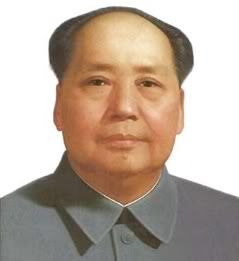
The Cultural Revolution was started in October of 1966 by China's Chairman Mao (pictured to the left). Mao wanted to completely remodel, or 'purify,' China, and he wanted complete and organized control. In the ten years of the Cultural Revolution, he got that.

In order to get support for the Revolution, Mao set up the Red Guards, an organization of student supporters. The Red Guard quickly became wildly popular-- in part because Mao, who was greatly admired by most of the people of China, praised it so much-- and almost every young student dreamed of joining it one day.

The Red Guard was one of the main forces of the Revolution, and helped greatly in achieving the Revolution's goal: to destroy the 'four olds.' The four olds were old ideas, habits, customs, and culture. By getting rid of the four olds, they were also getting rid of an old way of thinking-- the Revolution was as much a revolution of the minds of the people as of a country.

But the destruction of the four olds-- and everything to do with them-- was very violent. Anyone suspected of being traitorous of Chairman Mao could be killed. Innocent people were forced out of their homes, fired from their jobs, forced to work without pay 'for the good of the country,' murdered, tortured, publicly beaten, and so on. Public humiliation was another popular process of punishment Some victims were made to kneel without moving for hours on broken glass while their houses were torn apart in a vicious search for any kind of incriminating evidence. Some families that needed to 'rethink' their loyalties were relocated to farms out in the country, where they had to perform back-breaking labor for the nation.

Another goal of the Revolution was complete equality. Mao's government blamed the upper class of doctors, lawyers, teachers, and especially landlords, for the suffering of the poor. So anyone who was in any of those professions, and their relatives-- no matter how distant-- were suddenly criminals. The Red Guard locked up, tortured, and killed China's upper class-- something that was, essentially, the nation's suicide. They were murdering the brightest and most important minds in their country... all in the name of equality.

So despite its initial wild popularity, members of the Red Guard began questioning the ethics of the Revolution. The movement lost momentum, and popularity faded. The official date of the Revolution's end is 1977, one year after Mao's death.


I got most of my information from a book I read several years ago called 'Red Scarf Girl,' which is the true story of a young girl in China during the Revolution. The rest of my information comes from http://acc6.its.brooklyn.cuny.edu/~phalsall/texts/chinhist.html . The picture is from photobucket.com

Wednesday, March 28, 2007

Assigned Post: Ghost Stories

In English, we are currently reading The Woman Warrior by Maxing Hong Kingston. In the chapter that we just read, Maxine's mother tells many ghost stories to Maxine and her siblings. In class, we told our own ghost stories, and Mrs. Watson asked us to post them on our blogs.

Many years ago, my high school was a boarding school, and students lived there for the entire school year. Castle Hall, a building now used for art, was the location of the girls' dormitories. The following story is one that people in my school love to tell-- among our other school ghost stories-- and takes place in Castle Hall during the old boarding school days.

Late one night, during the last few months of school, a girl woke her room-mates in a panic, telling them that the school was on fire. The girls looked up at the long, thin windows at the top of the wall that separated them from the hallway-- and sure enough, they could see flickering firelight through the glass panes. But before they could do anything, they also heard chanting-- chanting in Hawaiian.

"It's the Night Marchers," one dark-haired girl said in a hushed voice.

[To anyone who does not know what the Night Marchers are, please read this short Wikipedia article: http://en.wikipedia.org/wiki/Night_marchers ]

"What are you talking about?!" snapped the first girl. "Don't be so superstitious! It's a fire, and we need to warn people!" With that, she ran to the door and seized the handle. As soon as she touched the knob, she screamed and jerked her hand away-- it was horribly burnt.

Almost instantly, the chanting stopped, and the firelight disappeared. Soon after, the girls could hear people running to their room to see what had happened. Teachers took girl with the burnt hand was taken to the hospital, leaving the others to whisper about what had happened.

The dark-haired girl told the others about the chanting and the light of the torches, and how she suspected it was the Night Marchers.

"But why would the Night Marchers be up here on the second floor of Castle Hall?" asked another girl skeptically.

"Well, there used to be a hill here, right? But they bulldozed it to make the building. When the Ancient Hawaiians were here, the ground was probably around the same level as this floor is. So they're still marching where the ground was then, when they were alive."

A few of the girls remained disbelieving, but most of those who had seen their friend's burnt hand were not so quick to deny that maybe the legend was true, and that their school-- like so many stories told-- was haunted.

There are many tales of ghosts in our school, but I chose this one because I spent a year in the same classroom where this story takes place.

Thursday, March 22, 2007

Free Post: 'At World's End' Trailer

Over Spring Break we were asked to make two free posts, but I decided to put this up in addition to the other two.

A few days ago the teaser trailer for 'Pirates of the Caribbean Three: At World's End' came out. I love 'Pirates of the Caribbean,' so I'm putting the trailer up. I know that it doesn't relate to English, but I was so excited when I saw it that I can't resist. So here it is (sorry that the film quality isn't that good, but the trailer itself is great so it makes up for it) :


I think I speak for all 'Pirates' fans when I say "SQUEEEEEEE!!" I cannot wait for May 25th... But what I want to know is why is it that Barbossa has more face time than any of the other characters? I mean we almost see him more than Jack! And why does Norrington (he's an Admiral now! :D ) only get a split second while Beckett gets more screen time than Elizabeth?! What is going on here?! *obsesses*


Yeah... sorry but I had to rant. I'm going slightly insane because May 25th is two months and one day away and that is WAY too long. Now I'm off to look for spoilers.

Wednesday, March 21, 2007

Free Post: Old-Fashioned Voices, Part Two

In my previous post, I talked about the different kinds of old fashioned voices. Now I'm going to try to figure out when those kinds of voices died out.

I used clips from the movies 'Casablanca' and 'The Lady Eve' as examples of old-fashioned voices. Both of these movies were made in the early 40's, a time when old-fashioned voices were still going strong. The government video with the voice of Edward R. Murrow was made in 1951-- but Murrow was older then, and is more famous for his radio broadcasts in the 40's. So we don't know if old-fashioned voices were still used among younger people in the 50's. However, I think it is safe to say that they were, because people were still using them well into the 60's, as can be seen from this clip of the 1964 black comedy film 'Dr. Strangelove':


The accents continued on even into the 70's, as shown by this movie trailer for the 1977 'Star Wars: A New Hope' :


But by the time the 'Star Wars' saga reached 'The Phantom Menace,' old-fashioned voices were almost gone:


When I watched this clip, I was expecting no traces of any old-time accents. But to my surprise, Chancellor Palpatine (played by Ian McDiarmid) has an old-fashioned voice. However, McDiarmid was born in 1944, when old-fashioned voices were the only way people spoke. He was 55 at the time the film was made, and was probably one of the last people to have that accent. Younger people at that time did not have the accent, as can be seen from the younger characters in the movie.

I want to find out when younger people lost the old-fashioned voices. 'Phantom Menace' was made in 1999, so somewhere between then and the 70's, old-fashioned voices all but died out.

'Back to the Future' was made in 1985, and it stars mostly younger actors. This clip shows that by that time, old-fashioned voices are gone. Neither character in this clip-- even Doc, who seems old enough to have an old-fashioned voice-- has an accent:


So now we know that sometime between 1977 and 1985, people stopped being born with old-fashioned voices.

The 1980 Oscar-winning movie 'Apocalypse Now' narrows down the time frame even further. In the famous 'I love the smell of napalm in the morning' scene, there are no old-fashioned voices present:


So at some undetermined point between 1977 and 1980, old-fashioned voices died out. I doubt that anyone speaks with that kind of accent today. Yes, the voices of the past lasted longer than the technology. We heard the accents long after black-and-white film was replaced with color and record machines with tape players and later with CDs. But like everything else from that time, the voices eventually faded away, along with the people.

Monday, March 19, 2007

Free Post: Old-Fashioned Voices Part One

I really love watching old black-and-white movies--like Casablanca, North by Northwest, and other WWII-era movies are my favorites, but I also enjoy Charlie Chaplain-type silent films. What I've noticed in the films that do have sound is that the all the actors and actresses have slight accents. They're not exactly British, but not modern American either-- more like a mix that is distinctly, for lack of a better word, old. I call them 'old-fashioned voices,' and I decided--since it's Spring Break and I have the time-- to try to figure out when they started and when they stopped.

First, here are samples of different accents that all fall under my category of old-fashioned voices:

This clip from the movie 'Casablanca' has several accents in it, but the only character with the accent I'm looking for is Rick-- the other characters are not American and therefore have a different, more foreign old-fashioned voice that I'm not focusing on. Just listen to Rick's voice to hear the 'Tough American' old-fashioned voice. Humphrey Bogart, the actor who plays Rick, is the perfect example of that kind of accent:


Another common accent is the one that most women spoke with. In this clip from the movie 'The Lady Eve,' Barbara Stanwyck, the actress who plays Jeanie, is another perfect example:


The other most-heard old-fashioned accent is the more official, radio-announcer type voice as can be heard here in the voice of Edward R. Murrow in a (rather inaccurate) government safety film on atomic attack:


Murrow's accent is very apparent, but very much absent in the voice of David Strathairn, who plays him in the recently made movie 'Good Night and Good Luck':


Old-fashioned voices are the kind of voices you hear coming from record machines and grainy black-and-white films. No one speaks like that anymore. They are one of the marks of the past, and they've been washed away along with the 'inferior technology' and 'ignorance' of those times. Yes, it is easy to laugh at the government's earnest black-and-white Atomic Safety video that tells you to close your blinds in case of nuclear attack. But those times-- at least for me-- also hold a romantic, sometimes even innocent, feeling that will probably never be captured again.

Thursday, March 15, 2007

Essential Question Response: Rain

This post is in response to my essential question 'what will make my happy?'

I love rain. Where I live, here in Hawaii, rain isn't cold or sleety and doesn't mean danger of hail or pneumonia or thunderstorms with striking, burning lightning. Rain here is usually warm, even when it's torrential, and if we do have a rare case of a thunderstorm, the lightning comes in sheets that brighten the sky.

Sometimes my favorite kind of rain is the kind that goes on and on and on without stopping, like the winter when it rained for 42 days straight. The kind of rain that makes endless puddles and cancels sports practice. The kind of rain that will soak you in seconds. The kind of rain that gives you the excuse to take off your nice school shoes and go barefoot. The kind of rain that you can dance in, run around in, the kind of rain that makes you shriek with joy like a five-year-old, even if you're 15. The kind of rain that spurs you and your sleepover friend to creep out in the middle of the night and run around in the dark, just to feel the water on your skin, just for the thrill of being out there when no one knows you are, enjoying something that no one else is.

Sometimes my favorite kind of rain is the kind that comes with thunder. It's one of the most satisfying feelings in the world to, after months of cloudless humidity, hear thunder booming and see a storm coming. To smell that wonderful smell as the cool rain hits the hot asphalt on the streets, patters gently at first and then pours down on the palm trees outside. It's a beautiful cozy feeling to curl up, dry and warm under a blanket, and watch the rain pound against the skylight. And then, when it
suddenly stops to make way for the sun and a rainbow, to run outside and splash, smell the grateful earth that is renewed and the plants that are refreshed, and feel the new life everywhere.

But usually, my favorite kind of rain is the kind that comes lightly on and off, the kind that as far as I know is unique to Hawaii. I love walking outside and looking up at the sun, still shining bright, as fine rain oh-so-gently drifts down to meet the earth. I love seeing a rainbow stretch across the sky, the beautiful, still-magical rainbow that is the combination of the sun and rain. I love going through the tunnels, going in dry on one side and coming out on the other side to find that in the span of a few seconds, the rain has taken over-- or maybe it was there all the time, hiding on the other side of the tunnel and choosing not to venture to the other. I remember driving with my dad on the freeway, looking forward and seeing, with great anticipation, the raincloud up ahead. The surprisingly sudden pouring of water on our windshield, the wipers going full time. Rolling down the window, leaning out with my face to the sky, letting the rain come down on me. And then just as suddenly as we entered it, we left the miniature torrent behind and were driving againg through sunlight.

It's rare when I view rain with a groan. Umbrellas are usually an annoyance-- why would I want to carry one around when there is water falling from the sky? Have you ever thought about that? Not in terms of science, of condensation and precipitation, but of water that comes out of nowhere and, almost magically, begins to fall from the sky. It's beautiful.

I remember a line from a song that I think was written by the Beatles: 'If the rain comes, they run and hide their heads; might as well be dead...' Yes, on the Mainland or in the Beatles' Britain, where weather is cold and rain probably isn't too pleasent, yes, there I would take cover. But here? Why would someone in warm Hawaii run inside when they could be running outside? Why huddle in a cold classroom or under an overhang when you could drop your bag and binders and folders and devote your break to the rain? Why not abandon dignity, for now? Take a few steps forward, lift your face up, spread your arms: embrace the rain.

Wednesday, March 14, 2007

Family Stories, Part Two

The second and final part of my Family Stories project is up now in podcast form at the bottom of my blog. Check it out if you want. Although you'll be forced to hear my voice. Sorry about that part.


Anyways, happy Pi Day (March Fourteenth: 3/14: 3.14(159265etc.)). Have some pie to celebrate.

Monday, March 12, 2007

Essential Question Response: After College

Because Essential Questions are made for the purpose of figuring out who we are, they-- like us-- can change at any time. So I decided to temporarily change my second essential question to 'What is in my future?' That is the question I am responding to now.


Although I'm a Freshman, I often think about college, and what comes after. I don't know what college I want to go to (although I do want to go out-of-state), but I think I know what I want to do afterwards. I really love my school, and I want to come back and teach here after college. I'd love to teach a history or English course, and I'd love to be involved in the school's band even if my marching days are over. This school is one of my favorite places in the world, and coming back here would be like coming home. I'm someone who places great value in opportunity. I love going to a big school because of the countless things you can do, classes you can take, and people you can meet. Teaching here could open up even more oppurtunity than being a student.

Of course I will probably change my mind-- it's too long a time with too much happening for me to think that I'll be the same after I graduate as I am now. And even if I don't change my mind about teaching, I may want to work at a college (as my friend Herena said, "No! Don't be a teacher! Be a professor! Teachers are mortals.").

But I do know that after graduating I would like to come back to my home state and live there-- where the weather is nice like the people-- and I'll be home: close to family, and if I still want to, able to teach at my high school.

Thursday, March 8, 2007

Essential Question Response: Friends

This post is a response to my Essential Question ‘What will make me happy?’

I recently saw this video on someone else’s blog, and I really liked it:


There are two reasons this video makes me happy to watch.

The first is, I’m pretty sure, the same reason it makes other people smile: it’s a moving and inspiring story that makes you feel like even the smallest gesture can escalate into a huge movement that really makes a difference. That’s what happened with Free Hugs—now people from Korea to Amsterdam are involved in it, and are, in a little way, making people happier.

The second reason is that it reminds me of my friends. Where I hang out at school (a place called the Alley… I don’t know who named it or why, so don’t ask, but it’s not a real alley), we have a form of free hugs called ‘glomping.’ A glomp is a ‘sudden and random hug-attack that comes out of nowhere and needs no explanation’ (definition courtesy of one of my friends). The first few months of school you could hardly take a step in the Alley without being glomped. It’s died down a bit by now, but there are still times when someone will suddenly go on a glomping spree. And if someone is feeling upset—and looks like it—it’s not unusual for them to get a hug. Sometimes glomps are just as a joke—one of my friends once glomped another guy and then sang ‘You’re Beautiful’ to him while kneeling—but other times it’s a gesture of comfort and friendship.

So I guess what I really want to say in response to my essential question is that my friends make me happy. They’re there to joke around with, but they can be serious if you need it. They never hesitate to comfort you if you look sad. Another thing I really love about everyone I hang out with is that we, to put it bluntly, have no shame. We’ll belt along to ‘Popular’ for irony’s sake (we’re pretty far from popular) even if the entire campus is staring. We’ll be fire hazards by doing a self-dubbed ‘foot-dance’ on the stairs even when there’s no music. We’ll jump around and call ourselves ninjas although most of us can’t even do a handstand.

So like the man in the ‘Free Hugs’ video, my friends aren’t afraid to do things that are usually dubbed as stupid or the farthest thing you can get from cool. Because of them, I laugh (sometimes up to the point of hyperventilation) every day. They make me very, very happy.

Wednesday, March 7, 2007

Free Post: Campaign Ads

Last week in English we were given around ten minutes to free-write about any [appropriate] topic we wanted to. Belatedly, I’ve decided to use this as an excuse to post on a topic that isn’t assigned.

Today when I was riding home from school with my dad, we listened to a recent NPR broadcast on his iPod about political campaign ads. They played ads dating back from the first televised presidential campaign ad: Ike Eisenhower’s Disney-produced cartoon jingle in 1952:

My first reaction to hearing this was incredulity that someone would actually run this for a presidential campaign. But the interesting thing is that, back then, it worked. Or at least it didn’t too much harm—Eisenhower won that year in a landslide election.

Anyways, I got to thinking about what would happen if that kind of ad was played today. I think it would go something like this:

Ad: Bush for President, Bush for President, Bush for President, Bush for President…

Viewer: …what…

Ad: You like Bush, I like Bush, everybody likes Bush (for President)

Viewer: BAAAHAHAHA!

Ad: We don’t want John or Hillary or Barack…

Viewer: Yeah OK not voting for creepy jingle man.

But in the fifties, the commercial was a success. Eisenhower’s idea of putting a political ad on TV quickly caught on. While some politicians such as Adlai Stevenson condemned the idea of political ads ("The idea that you can merchandise candidates for high office like breakfast cereal is the ultimate indignity to the democratic process."), most presidential campaigners followed his example and used the television as communication with their voters. Some worked better than others: ads such as the one that can be viewed here: http://www.cnn.com/ALLPOLITICS/1996/candidates/ad.archive/stevenson.mov were not as successful as the strategic attack ads that were later developed, such as this one: http://livingroomcandidate.movingimage.us/election/index.php?nav_action=election&nav_subaction=R&campaign_id=172

Attack ads, though often viewed as unnecessary, are effective. Possibly the most famous attack ad in campaign history doesn’t even mention the name of the candidate’s opponent—but was what some historians view as the message that was the final push that won Lyndon Johnson’s 1964 campaign. It is easy to see why the message was so effective:

It plays off of fear, and also subtly lays the blame on Johnson’s opposition, a man named Goldwater who was noted for his aggressive war tactics and wishes to use nuclear weapons in the war on Vietnam.

This ad is more similar to those played today than that first innocent, jaunty jingle ad run by Eisenhower in 1953.

A recent attack ad run by President Bush in his 2004 campaign ad against John Kerry also plays on fear:

Like the ‘Daisy Girl’ ad, this ad was successful. But this ad was also more than bit a misleading: Kerry suggested budget cuts in the 1990s, before the terrorist attacks—but he wasn’t the only one: so did some Republicans on Bush’s side.

So as you can see, as our country has developed, successful campaign ads have turned from happy jingles with parades, to atomic explosions and killing of children, to misleading attacks on opponents. We’ve gone from positive ads playing on positive things to almost threatening ads that play on fear. I’m not sure I like what that says about our country.

Sunday, March 4, 2007

Magical Realism, Part 2

This is the second and final part of my magical realism project. In this version of the story, there is magical / unexplained stuff mixed in with the actual story.

When my dad was six years old, he went with his family—his sisters Laura and Susan and his parents Malcolm and Eleanor— to the New York World’s Fair. Afterwards, before heading home, they stopped at Jones Beach on Long Island. That was where my dad saw the ocean for the first time in his life. He and his sisters were fascinated by it, and, not having bathing suits, went wading as deep as their parents would allow them. But despite their efforts to keep dry, they quickly got soaked due to their inexperience with the ocean. After that, they gave up on wading and began playing around in the water, splashing each other and diving under crashing waves.

Their parents watched them, having long since given up on trying to keep them dry. After a few minutes, Eleanor noticed something strange about the water. Every time a wave rose up to break, it would—so fast it was almost impossible to see— become almost black in color. She pointed this out to her husband, who also began to watch carefully. They noticed that the flashes of black were only happening on their stretch of beach—there was nothing wrong with the whitecaps far out at sea or the other waves further down the beach. But then another family arrived, the parents settling down on the sand nearby as the children ran to the water. As soon as the first child leaped into the ocean, the waves there began to do the same thing. Nervously, Malcolm called Tom, Laura and Susan out of the water and told them to play in the sand.

So the children turned to fort-making and sand-ball fights. The grown-ups retreated up the beach so as to keep clean, but kept two pairs of wary eyes on their oblivious children. Within minutes the kids were covered with sand from head to toe. But to their parents’ consternation, they returned to the water after Laura got sand in her eyes.

Their parents watched the waves—which, in their area, had returned to normal after their children had left the water—as the three kids dove in. Sure enough, the black flashes started immediately. Just as their mother was going to call them out of the water again, there was a shriek from down the beach. Eleanor and Malcolm looked over to see the family who had been sitting near to them hurrying back to their car, the father carrying one of the girls, whose foot was bleeding very badly.

Eleanor and Malcolm looked at each other nervously. A bleeding foot could be caused by a rock, coral, broken glass… it was nothing that couldn’t be easily explained. But water flashing black was different.

So they gathered up their towels and umbrellas, and loaded their soaked and sandy children into the car. On the ride home, they patiently listened to the endless chatter about the sand, the waves, and the water, not saying anything about the strange things they had seen.

Magical Realism, Part 1

In English, we're currently learning and writing about magical realism (http://en.wikipedia.org/wiki/Magical_realism) in connection to another theme; family stories. We were told to choose a family story and write it out, and then rewrite it adding elements of magical realism. This is the first part of my magical realism project-- the story as it happened, with no imaginary elements added.

When my dad was six years old, he went with his family—his sisters Laura and Susan and his parents— to the New York World’s Fair. Afterwards, before heading home, they stopped at Jones Beach on Long Island. That was where my dad saw the ocean for the first time in his life. He and his sisters were fascinated by it, and, not having bathing suits, went wading as deep as their parents would allow them. But despite their efforts to keep dry, they quickly got soaked due to their inexperience with the ocean. After that, they gave up on wading and began playing around in the water, splashing each other and diving under crashing waves.

Their parents watched them, having long since given up on trying to keep them dry.

Water fights quickly ensued, and then fort-making and sand-ball fights out of the water. The grown-ups retreated up the beach so as to keep clean, but the kids had no such intentions. Within minutes they were covered with sand from head to toe. After Laura got sand in her eyes, they returned to the water and the still-novel idea of waves, which they had never seen before.

Finally, after several hours, their parents intervened and reluctantly loaded their soaked and sandy children into the once-clean car. On the ride home, they patiently listened to the endless chatter about the sand, the waves, and the water, until finally the kids succumbed to their exhaustion, and fell asleep.

Thursday, March 1, 2007

Essential Question Response: Small Acts of Kindness

This post is a response to my Essential Question ‘How do others view me?’

Last summer, I went to Seattle with my mom for about a week. I had a lot of fun on that trip, but the thing that I remember the most was this experience:

We were walking back to our hotel from the restaurant where we had eaten dinner. During our various walks over the course of the trip, I had noticed that Seattle had a big homeless problem, and this walk was no exception. I looked down as a homeless woman sitting in a doorway shouted to the man walking in front of us that if he had any food she needed it, because she’d just had another baby and she was hungry. The man said at least three times that he was sorry, but he didn’t have anything with him. He sounded genuinely sorry.

I looked at the container of leftovers my mom had taken from the restaurant, and I nudged her to say that we should give it to the woman. My mom walked over and handed it to the woman, who opened it to check what was inside and then thanked her.

As we walked away, the man in front of us turned around and said “Hey, thanks for doing that, that was a great thing to do.” After a moment he turned around again to say “No, really, I mean it, that was really cool.”

I grinned, suddenly boundlessly grateful for him to do something harder than we had done—turn around to thank two strangers for a small gesture that otherwise would have gone unnoticed. If he hadn’t said what he did, I probably would remember that event with sadness because of Seattle’s homeless. Instead I remember it with not just sadness, but a bit of hope and happiness, because of the man who recognized a good deed—however small—and said something about it.

Essential Question Response: Family

In this semester of English I, the question guiding the course is ‘who am I?’ Everyone has chosen one or two Essential Questions, and we are to respond to the question or questions twice a cycle. My two Essential Questions are ‘How do others view me?’ and ‘What will make me happy?’ Today I am responding to question ‘What will make me happy?


As I said in my last post, my Pomper is in currently in the hospital with heart problems. This past Sunday he was flown out to California to have surgery in Stanford. My grandmother and uncle went with him, and my mom is flying out tonight to be there the day of the surgery, which is set for tomorrow—Friday.

Because of everyone's worry over Pomper, we've had more 'family time' in the past week than we've had in a while. And though I usually prefer hanging out with friends to being with family, this week it's been very welcome. And what I've realized is that I should spend more time with my family even when things are normal. If something had happened to my parents or my sister in the past year-- if one of them died-- I would have had too many regrets to count. Most of all I would regret not spending enough time with my family. Now I'm starting to realize that I need to be with them more.

I used to take my family for granted—I think most people do. We assume that our parents will always be there to forbid us from doing something, that our siblings will always be there to argue with, that our grandparents will always be there to spoil us. We don't want to be with them, and when we are with them we take them for granted. I don't want to have that kind of relationship with my family. So regardless of the outcome of my Pomper's surgery, I want to spend more quality time with my family, because I don't want to take anyone for granted again.

Rollercoaster

Rollercoaster
A nice picture my friend took on the Rose Parade Trip of a Knott's Berry Farm rollercoaster

Grace Kelly Song

'White and Nerdy' by Weird Al

Kitten is Angry

Potter Puppet Pals: The Mysterious Ticking Noise